
Most people think a portfolio website should either feature high-end 3D designs and moving components, or the polar opposite: just a plain, barebones HTML file.
Before analyzing one's profile, I often see developers deploying portfolios crafted like a full macOS or Windows operating system theme.
However, in reality, it doesn't take all that over-engineering.
“Simplicity is the ultimate sophistication.”Leonardo da Vinci
What Is It Really?
Your portfolio website is a direct reflection of what you do and how you do it.
For example, if you are a frontend-heavy developer, your website should demonstrate:
- Optimization and performance
- Refined design taste
- Good design sense and typography
Or if you are a backend developer, your website might feature blogs and case studies on:
- System design
- Database optimization
- Caching strategies
- Backend engineering architecture
Moreover, it demonstrates your expertise in building high-throughput systems.
Ultimately, it is a living reflection of your work.
The Initial Traction
Here is the analytics breakdown of this website in the first week of launch:
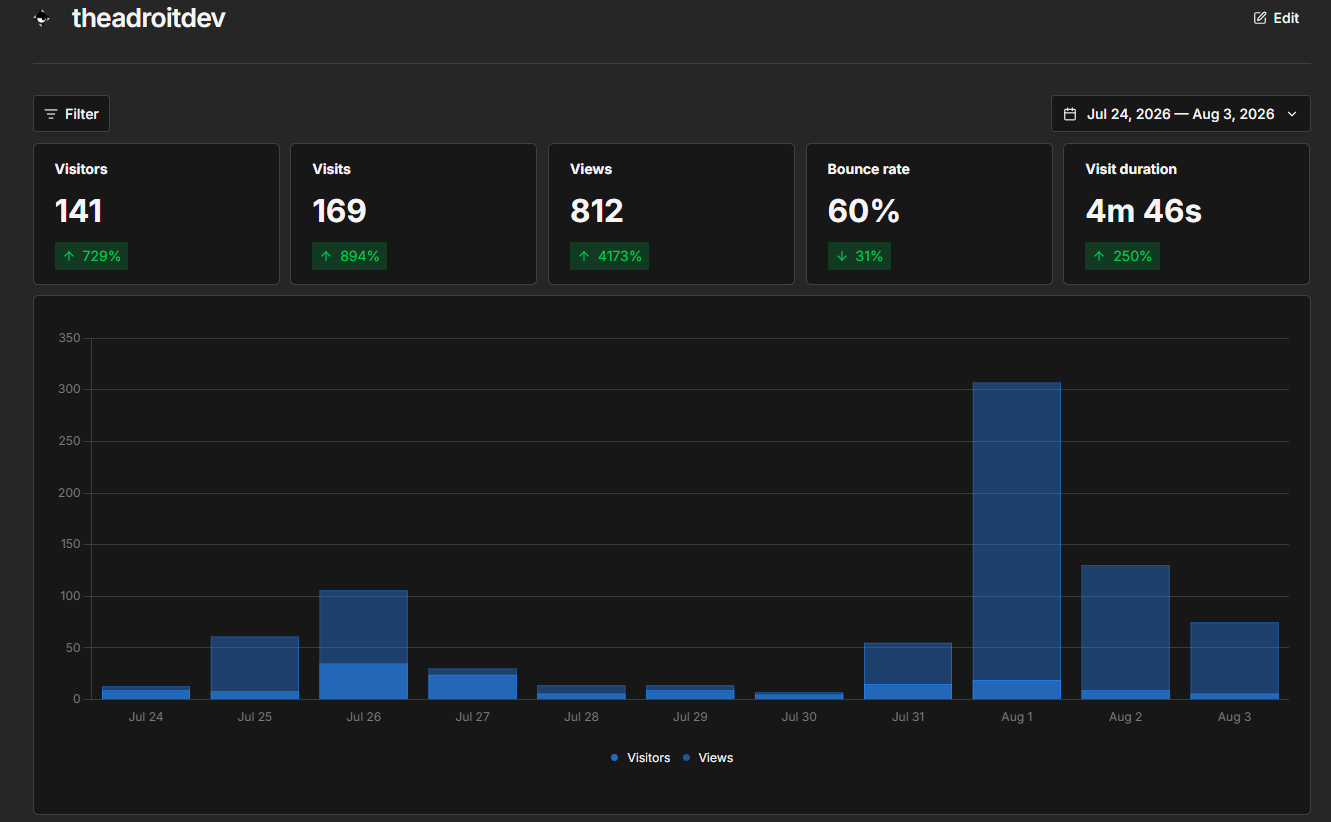
btw Thx everyone
Making your portfolio a success:
1. Provide Value Through Your Website
This is a crucial point to cover. In this age of AI, fewer people are writing authentic content. Most of the web is turning into AI slop.
Your motive should be to provide so much value that your website becomes inherently shareable.
When your content is shareable:
- It catches more eyeballs
- It gets more attraction and traction
- It opens up far more opportunities
Because in the end, attention is the ultimate currency. Don't just dump your projects onto a page and make it look like a boring resume.
2. Show Stories, Not Only Projects
Most developers create a project, dump a GitHub link on their page, and pick a random screenshot.
That is the wrong approach.
Treat your project like a product. Don't just leave it on GitHub where no one is going to inspect your code repository blindly.
For example, if you are building a component library, ask yourself these questions:
- What specific problem did you solve?
- What uniqueness does it bring to the table?
- What real impact did it have? (Use concrete numbers and analytics)
Package it into a compelling story. In order to attract opportunities, you have to make your work appealing and present it beautifully.
Even if you built clone projects, they can still carry your unique engineering perspective.
3. Avoid 2015 Designs
Put dedicated time into refining these design fundamentals:
- Spacing
- Typography and Font Hierarchy
- Whitespaces
- Modern Design Principles
The more great design you consume, the better your taste becomes. Surround yourself with great designers and inspirational work.
Once you have a strong design eye and your portfolio looks aesthetic and hireable, your conversion rate skyrockets.
You have a much higher chance of people reaching out to you.
4. Make It Interactive & Memorable
Why should your website be interactive?
Because subtle, tasteful micro-interactions leave a lasting impression.
For example, hovering over your social links showing a smooth tooltip with the platform name elevates the user experience significantly.
A big warning: Don't overdo motion by blindly pasting component library animations (like Aceternity UI or Magic UI) everywhere.
Stuffed animations look chaotic. You don't need your website to be a showcase of library components.
Additionally, make your website memorable.
For instance, Ram's website features a subtle moving doggo.
Add a small, unique detail that connects visitors to your personality.
5. Position Yourself Correctly
Think of it this way: Just as you tailor your resume for specific roles, you need to tailor your portfolio website for your target domain.
Avoid generic, vague terms like "Frontend Dev" or "Backend Developer".
When a recruiter or hiring manager lands on your site, the first thing that needs to click in their mind is:
What is this person exceptionally good at?
Compare:
Frontend Dev vs Client-Side Engineer & Interfaces Specialist
Which one looks more compelling and expert-level?
Yes, The right side!
Position yourself as an expert in your niche.
If you are a Backend Engineer or Full-Stack Developer, write about:
- Why system design matters
- How to optimize your frontend and backend performance
- How to deploy and scale production applications
This is called niching down.
Position yourself as the exact person for the job.
At the end of the day, everyone wants someone who can solve their specific problems.
“It's not just who you are, but what you can do for them.”
6. Treat It Like a Product
If you don't treat your portfolio like a product, you won't polish it like one.
Why should your portfolio feel like a SaaS or product? Because products are designed around user experience, clarity, and delivering immediate value.
7. Be One Click Away
You should be approachable with a single click.
Don't make the recruiter wait or click on some email address for them to draft an email.
Conclusion
It's all providing, value, story-telling, and positioning.
Treat your portfolio as a living product - polish your typography, package your projects into compelling case studies, add subtle micro-interactions, and make reaching out completely frictionless.
Focus on providing genuine value over noise, and your portfolio will naturally start opening doors, attracting visitors, and convincing hiring managers.
Build something remarkable!
“Thank you for reading 💖”